
On the morning of July 2nd, 1937, Amelia Earhart lifted off from Lae, Papua New Guinea, and flew into the most famous disappearance of the 20th century. The official story says she crashed into the Pacific and sank. And yet, evidence now shows the distress calls kept coming for days, the castaway campsite was discovered on a remote atoll, and a strange shape was spotted on Apple Maps in 2020. Now, with an expedition setting out to finally identify the object buried off Nikumaroro, the mystery of what really happened to Amelia may be about to break wide open.
Subscribe on Patreon to stay up to date on all things HSP with our newsletter, bonus content, and more. If you want to dive deeper into a community of fellow darkly curious listeners, upgrade for ad-free listening, monthly bonus episodes with topics voted on by members, merch perks, and Patreon-only group chats. High Council members also get Footnotes, our weekly after-show where Kaelyn dives deeper into the episode, recent true crime news, theories, and other scary stories from around the internet.
You can also enjoy many of these same perks, including ad-free listening and bonus content when you subscribe on Apple Podcasts .
Follow on Tik Tok and Instagram for a daily dose of horror.
SOURCES
https://www.history.com/articles/amelia-earhart-disappearance-theories
https://www.purdue.edu/newsroom/2025/Q4/expedition-to-search-for-amelia-earharts-plane-postponed-to-2026/
https://www.archaeologychannel.org/taraia/
https://www.nbcnews.com/news/us-news/amelia-earhart-may-have-survived-crash-landing-never-seen-photo-n779591
https://www.nationalgeographic.com/history/article/amelia-earhart-disappearance-theories-spd
https://www.nationalgeographic.com/history/article/amelia-earhart-aviation
https://airandspace.si.edu/explore/stories/amelia-earhart
https://www.womenshistory.org/education-resources/biographies/amelia-earhart
https://tighar.org/Projects/Earhart/Archives/Research/ResearchPapers/Brandenburg/PostLossSignals/PostLossRadioAnalysis/PostLostRadioAnalysis.pdf
https://www.cbsnews.com/colorado/news/finder-of-potential-game-changing-earhart-picture-tells-story/
https://www.npr.org/sections/thetwo-way/2017/07/06/535861448/does-a-newly-discovered-photo-show-amelia-earhart-survived-a-crash-landing
https://tighar.org/Projects/Earhart/Archives/Research/Bulletins/84_JaluitPhotoFINAL/photo_in_book.jpg
https://www.nationalgeographic.com/history/article/remembering-two-icons-amelia-earhart-search
https://utd-ir.tdl.org/collections/b10bd01d-7b14-43b2-a5dc-b9065b084e66/search?spc.page=2
https://web.archive.org/web/20100108193717/http://tighar.org/Projects/Earhart/Books/BookReviews/earhartsurvive.html
https://www.latimes.com/archives/la-xpm-2003-nov-23-me-then23-story.html
https://www.nytimes.com/1970/11/11/archives/new-earhart-book-called-nonsense.html
https://tighar.org/Projects/Earhart/Archives/Documents/Lambrecht's_Report.html
https://tighar.org/images/maps/worldflight.gif
https://tighar.org/images/lambrecht.jpg
https://media.npr.org/assets/img/2017/07/06/gettyimages-3308131-498aa3c19b35262b968b68ab55260ad813bc34f6.jpg?s=1600&c=85&f=webp



TRANSCRIPT
In 2020, a man was at home, scrolling through satellite images on Apple Maps, when he saw something just off the coast of a small island in the pacific. It was something that looked like a plane underwater.
He shared it online, and immediately, some historians felt they knew what this was. Amelia Earhart’s plane.
There is actually an expedition set to go out this summer and see once and for all if this could be true, but it kind of blew the lid off of the Amelia Earhart mystery. Because other evidence that was found on this very island, doesn’t paint a picture of a plane crashing and sinking. It paints the picture of someone who survived on the island and waited for help for a very long time…
See, there is a LOT that we weren’t told about Amelia Earhart’s disappearance. And while the official story was that she crashed and sank into the ocean, I think we have plenty of evidence to prove that not only was that not true, but what REALLY happened to her might have been covered up. And I want to tell you all about that today.
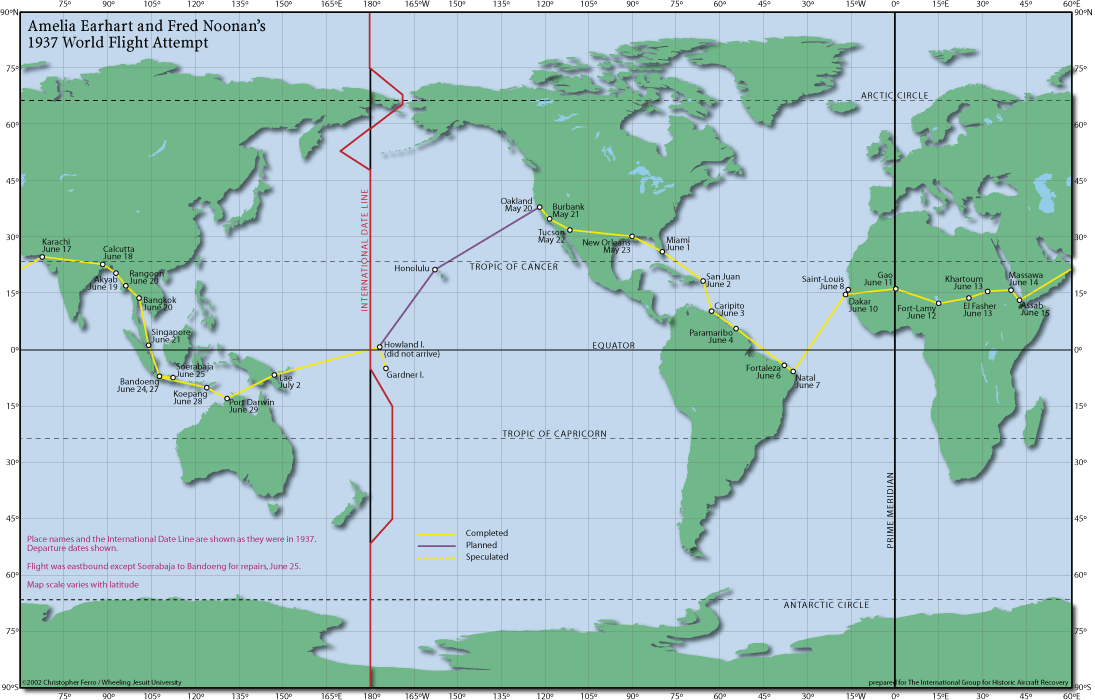
It's the morning of July 2nd, 1937, and Amelia Earhart is on the tarmac in Lae, Papua New Guinea, running her final checks. Ahead of her is the hardest flight she's ever attempted: twenty hours over open ocean to land on an island the size of a postage stamp. One of the last legs of her journey around the world.
The day before, she and her navigator, Fred Noonan, had stripped the Lockheed Electra of every spare pound of cargo, because every pound they shed was one more pound of fuel, and on this leg, a single gallon could be the difference.
But this day, the radio was acting up. First a short in the wiring, then a blown fuse. Without it, she'd be flying blind. Amelia keys the mic. "KHAQQ calling tower, check." A beat of static… then, "Tower to KHAQQ, we copy you." The radio works. The storm on the horizon is still miles off. She’s almost home "Tell Fred I'm rolling to him."
To understand this moment in Amelia’s life, you have to go back. Because by 1937, Amelia Earhart was the most famous woman in the sky.
She'd become a household name a decade earlier as the first woman to cross the Atlantic by air ( as a passenger ) and then spent the years since proving she could do it herself: the first woman to fly solo across the Atlantic, the first person of any gender to fly solo from Hawaii to California. She'd befriended Eleanor Roosevelt, who personally leaned on the State Department to help make this trip happen.
And now she was ready for the biggest challenge yet, becoming the first woman to fly around the world. But friends and fellow pilots would later wonder if she'd gotten a little too swept up in the myth of herself. If the need to keep topping her own records had crowded out plain common sense. She was about to turn 40, and she'd decided that if she didn't do this before her birthday, she never would.
Now, this was not going to be an easy trip to say the least. Even maxed out, the Electra could only fly about 4,000 miles before its tanks ran dry, that was not enough to cross the Pacific in one shot. So she'd have to stop and refuel halfway, on this tiny tiny island called Howland Island: one square mile of dirt in the middle of an ocean. Finding it would take extremely accurate navigating. Which is exactly why Fred Noonan was aboard. He was one of the best open-ocean navigators alive. the man who'd trained PanAm's entire navigation crew and crossed the Pacific eighteen times in a single year. If anyone could find Howland Island , it was him.
The trip had gotten off to a really rocky start. The first attempt, back in March, ended on a Honolulu runway when the Electra crashed on takeoff and had to be shipped home for repairs. So Amelia reworked the whole plan, reversing her route to fly with the prevailing winds instead of against them. That saved fuel, but it also meant saving the brutal Pacific crossing for the very end.
Now, Amelia trusted Fred with her life. Nobody questioned his skill. But Fred had a reputation as a drinker. he'd actually been let go by PanAm, and the rumor was that his drinking habit was why. This made amelia nervous but there was no backing out. This was one of the most anticipated flights in history and once they took off, it was in every newspaper around the world, the whole globe following their journey. Amelia wired a dispatch to the papers at every stop. But somewhere past the two-thirds mark, cracks started showing. From Calcutta, she called her husband, George and told him "I'm starting to have personnel trouble,". Now no one has ever been able to prove exactly what she meant by that, but everyone assumed she meant Fred was drinking again. Then came the monsoons, then one of their navigation instruments went down for a week, and then the radio blew a fuse. It was fixed, but started acting up all over again by the time they reached Lae.
From there she wired George one last cryptic line: It just read "Radio misunderstanding and personnel unfitness." People have argued for decades over what she meant. Fred? Or was Amelia herself simply running on empty?
Whatever it was, on the morning of July 2nd she settled into the cockpit on the tarmac at Lae, the clouds going grey in the distance, and told herself the same thing again: the radio works, the storm is miles away, we're almost home. The little silver plane gathered speed, lifted off, and climbed. The ground crew watched it go.
They would be the last people to see Amelia Earhart alive.
22 hours after takeoff, amelia still hadn’t landed at Howland Island, and now, no one could reach her on her radio.
Her last message, sent over an hour ago, said she reached the “line of position” of the island, and was now running north and south, up and down the line, looking for land. So she was, in theory, close.
The Itasca, a 250-foot long coast guard vessel, is docked off the northeastern side of the tiny island, hoping to make it stand out that much more from the air. The engines churn out a constant plume of black smoke as a makeshift beacon for Amelia to find
But every minute that ticks by solidifies the unthinkable. She’s not coming.
At 21:45 GMT, the Itasca eye-TASS-kah control room makes the call that will go down in history: Amelia Earhart is lost at sea.
The bulletin is broadcast everywhere – “all ships, all stations” – the navy, the coast guard, commercial radio operators. Amelia’s disappearance is the top headline of basically every newspaper in the world. The US Navy immediately dispatches its fastest ship, the Lexington, from Honolulu to lead the search efforts. But it will still take a week and a half for them to reach Howland.
In the meantime, the Itasca mounted its own search effort. But in the thousands of miles of surrounding ocean… where do you even start??
Amelia’s last broadcast to the Itasca said she was “on the line of position.” Meaning, they had traveled far enough east to reach Howland Island, but they couldn’t find it. And that had always been the biggest risk of this plan. So the Itasca set out to search the open water surrounding the island. Amelia’s plane was equipped with an inflatable raft that had been stocked with food and water. She had also trained for how to safely perform an emergency water landing. Her empty fuel tanks would help her here, providing some buoyancy to the plane, giving Amelia and Fred enough time to escape the cockpit and deploy the raft.
But the Itasca found nothing – no sign of a crash, no raft. They kept searching into the night using high-powered spotlights until a storm rolled in, churning the water with 10-foot waves.
From the transmission logs, it’s clear Amelia was having issues with her radio again. She was supposed to contact the Itasca every half hour, and likewise they were supposed to send weather updates. But the Itasca only received 10 transmissions over the course of the flight, some of them unintelligible, and Amelia heard only one of the weather reports.
Here’s why this matters: the radio was paramount to Fred’s navigation. He could determine their direction using the position of the sun and stars – celestial navigation – but the varying windspeed over the open ocean impacted the distance they’d actually traveled. So when Amelia radioed that they had reached the line of position, without the radio reports, this was probably just Fred’s best guess based on how long they’d been in the air. It’s also called , “dead reckoning”. And of the messages the Itasca did receive, two of them mentioned how cloudy and overcast it was. So who’s to say Fred was even able to see the stars to navigate by.
In addition, the Itasca should have been able to provide directional bearings on Amelia’s plane. Based on where the radio transmissions were coming from, they could double-check that she was on course. But they weren’t able to get her bearings – and even if they had, the messages weren’t going through.
So, Knowing all this, the search party expanded their radius to other small island clusters in the vicinity – the Phoenix Islands, the Gilbert Islands, the Marshall Islands. In total, a squadron of 62 planes searched 150,000 square miles surrounding Howland. They came up empty-handed.
When no sign of Amelia was found – no wreckage, no life raft, nothing – they could only come to one conclusion. And this has been the official stance for decades: she had crashed over the open water and the plane sank to the bottom of the ocean before she had time to escape. She and Fred were dead and they’d never be found, the end.
This is the theory that has been most widely accepted – even Amelia’s husband eventually believed it was the case.
But it’s not the only theory out there. And in the last 90 years, we’ve found plenty of evidence to dispute it. And that’s what I want to tell you about today.
The first, biggest piece of evidence is the dock photograph.
in 2015, a retired U.S. Treasury Agent named Les Kinney is at his house, digging through a box of declassified files copied from the National Archive. It’s mostly a collection of reports from Naval Intelligence about the Marshall Islands, a collection of small islands and reef atolls roughly 800 miles northwest of Howland. The reports include details and surveillance gathered during WWII.
But Tucked in among the papers, Les Sees a black and white photo labeled “Jaluit Atoll.” He had seen it in the box before, skimmed past it, but for whatever reason today he really looks at it. In the photo, There’s a group of people gathered at the end of a dock. And two of the people on the dock look, much lighter skinned than the other ones, they kind of stick out
One of them is seated, their head half-turned, in profile. This person has short kind of wavy hair but their profile looks feminine.
And he thinks to himself, hey, that kind of looks like Amelia Earhart.
The other lighter skinned person in the photo is a man holding onto a poll. It’s hard to see his face but you can see that he has thick, dark hair, and his hairline has a very defined widows peak. It looks JUST like fred noonan.
In addition, Kinney identifies the Navy ship in the background as the Koshu, which was one of two Japanese destroyers in the area on the day of the crash. In the photo, there’s something tied up behind the ship, covered by a tarp. Based on the estimated dimensions, Kinney believes it’s the Electra.
But could it be? Could this photo be showing that Amelia and Fred landed in the Marshall Islands?
We know that, because of the radio issues, Fred Noonan was navigating by “dead reckoning.” If he was estimating their distance traveled based on their flight time, but missing the crucial information of wind speeds and radio bearings, maybe they hadn’t actually traveled as far east as he thought.
And when they start running north-south, about to run out of gas, desperately searching for Howland and finally spot an island, they land – but it’s not actually Howland, it’s one of the Marshall Islands.
Which, were controlled by the Japanese at the time. And subsequently, so the theory goes, they’re taken into Japanese custody.
And what’s interesting is this isn’t the only piece of evidence that the two had potentially been taken prisoner.
In 1960, Three men stationed at the Air Force base in Guam claimed they had found several witnesses who remembered seeing Amelia and Fred taken prisoner. They released a list of names and their statements. After it was published in the newspapers, at least one other independent witness came forward, Josephine Blanco Akiyama.
Now, before I tell you what Josephine saw, I need to take a quick geography detour. There are tons of little islands in the South Pacific, and this theory involves a bunch of them. So we’ve got Howland, the tiny speck Amelia was aiming for. Then we’ve got the Marshall Islands roughly 800 miles to the northwest, where Amelia might have landed by accident. Then there’s the Northern Mariana Islands another 1200 miles northwest of that. The largest of these islands is Saipan and the Japanese used it as military headquarters for all of their operations in the South Pacific. So if Amelia was captured anywhere in Japanese controlled waters, the most likely place she would have been taken was Saipan.
Okay, so back to Josephine. She grew up on Saipan. And one day when she’s 11, she’s running an errand for her sister, dropping off lunch to her brother-in-law who works at the Japanese naval base. When she gets there, there’s a crowd of Japanese soldiers out front, surrounding two white men. There’s lots of commotion, loud talking – the white guys don’t speak any Japanese. Josephine hangs back, just watching, she doesn’t want to get involved.
She overhears one of the guards use the word “her” – they say “where will we put her” – and Josephine realizes one of the men is actually a woman. Her hair is cut short and she’s wearing men’s pants, she’s never seen anything like it before. It’s such a novelty, the picture is burned in Josephine’s memory. And when she sees the headlines in 1960, she feels compelled to come forward and share her story.
And that's when the Japanese capture theory first really took off. Journalist Fred Goerner was so inspired by the Saipanese witness statements, he spent the next six years running down leads. He lead four “expeditions” to the South Pacific in search of clues. In 1966, he published a book with his findings, claiming that beyond a shadow of a doubt, Amelia and Fred were taken prisoner and died in Japanese custody.
Here’s how Goerner thinks it went down: Amelia and Fred crash-landed around Mili Atoll, the southernmost part of the Marshall Islands chain. They were discovered by a Japanese fishing boat, who alerted the Navy. There were two Japanese naval destroyers in the area that day – the Kamoi and the Koshu. Goerner posits that Amelia and Fred were taken onboard one of these ships and then they and the wreckage of the Electra were transported to the main base on Saipan, where they were imprisoned.
During his multiple expeditions to the area, Goerner interviewed several locals both on Saipan and the various Atolls. Again and again, people mentioned “the white pilots.” He found remnants of airplane wreckage in the harbor at Saipan – with dimensions that match the Electra. But it’s all circumstantial. Nothing was ever definitive. Until Les Kinney pulls that photo out of a box of files in 2015
I remember when this photo was made public – it seemed like, after all this time, the mystery had been blown wide open and we finally had an answer. The History Channel even aired a two-hour special featuring interviews with Kinney, other researchers, and many of the Saipan and Marshallese natives that spoke to Fred Goerner back in the ‘60s.
But in less than 24 hours, the whole theory collapsed. A Japanese blogger posted the original source of the photo: a travel book titled “The Life Line of the Sea, My South Sea Memoir” published in Tokyo in 1935, two years before Amelia and Fred went missing. So they couldn’t possibly be the figures on the dock. The blogger also proved that the ship in the background was the Koshu Maru, not the Koshu. An entirely different ship.
But just because this photo isn’t of Amelia and Fred, doesn’t mean this entire theory falls apart. There’s still the locals who remembered seeing Amelia on Mili, on Jaluit, and on Saipan. Can we really ignore their multiple accounts? Just because this photo was debunked, do we have to abandon the entire theory?
Because if we go back through the story of amelia earhart, there’s actually a lot that happened that wasn’t reported on at the time, and it also paints a very different picture than what the official reports said…
In his final report, after the search for Amelia and Fred ended, the commanding officer of the Itasca concluded that the Electra must have crashed over the open water and sank. He wrote that “all available land areas were searched, therefore Earhart’s plane was not on land.” In addition, “it was extremely doubtful that Earhart ever sent [distress] signals after 0846, 2 July.”
Well, no offense to that Officer but that is not even close to the truth.
In the first five days after her disappearance, there were actually over 100 radio signals. Some were only harmonic warbles or morse code dashes, but they were messages all the same. And they lay out maybe the most convincing argument that Amelia and Fred survived the crash, but weren’t rescued in time.
The International Group for Historic Aircraft Recovery, or TIGHAR is a nonprofit research group founded by Richard Gillespie in 1985. They’ve spent decades researching the Amelia mystery and compiled a thorough accounting of all of the messages heard in the immediate aftermath of the crash. These were taken from the radio logs of the Itasca, other ships in the area, nearby naval bases, commercial radio operators, and amateurs. TIGHAR believes that 57 of the radio transmissions can be qualified as “Credible Beyond a Reasonable Doubt.”
So, for example, at 7:00pm local time on July 2nd, the radio operator on the Itasca hears something on the line. It’s a woman’s voice, and it sounds like Amelia. He asks her to send long dashes in response. And then….silence. The Itasca doesn’t hear anything in reply, but two other ships, the HMS Achilles and the New Zealand Star, log in their radio report that they heard a series of long dashes at the same time. An hour and a half later, the Coast Guard station in Hawaii hears another series of dashes.
A similar scenario plays out again the next night. The commercial radio station in Hawaii, KGMB, makes a broadcast asking Amelia to send dashes on radio frequency 3105. This is important – only registered American aircraft are allowed to send voice signals on this frequency, so anything coming through on 3105 had to be from Amelia.
The KGMB broadcast goes out at 11:00pm on July 3rd. Over the next thirty minutes, the Hawaii Coast Guard, a PanAm operator, and a Navy ship all hear dashes on 3105 as well as someone trying to speak over the radio, but the transmission isn’t coming through.
There’s more examples of these near misses in the TIGHAR report, but you get the picture. The idea that Amelia never responded after her last broadcast just isn’t true. So why were these messages written off by the search party as false leads or hoaxes?
Well… because it made them look really dumb. They’ve just launched the biggest most expensive rescue operation in history and came up empty handed. If Amelia and Fred were out there, and the search party overlooked them, that would be a massive scandal. But, according to TIGHAR’s research, that might be exactly what happened.
Let’s back up for a second to Amelia’s last officially confirmed message: “We are on the line of position. We are now running north and south.”
Four hundred miles south of Howland is another little chain of coral reef atolls, the Phoenix Islands, and this has been suggested as a more plausible crash landing site than the Marshall Islands. Instead of dramatically changing course, turning back west, if Amelia and Fred were running north and south, it’s much more believable that they could have come across these islands, almost directly to the south.
There’s this one island in particular – back then it was called Gardner Island but today it’s called Nikumaroro nee-koo-mah-ROH-roh. It’s slightly bigger than Howland, about five miles long by two miles wide. And there’s an old freighter shipwrecked on the northwest side of the island, the SS Norwich City. But it’s kind of a funny shape, like a backwards “J,” with a huge lagoon in the middle. At low tide, there’s a long coral reef bed that presumably would have been long enough for Amelia to land on. And that’s what TIGHAR thinks happened.
When you look at all the radio logs compiled together, they noticed a clear pattern to when Amelia sent transmissions. They were always clustered around low tide. And there might have been a simple reason for that.
The Electra’s radio ran off of battery power. To avoid draining the battery completely, Amelia could have waited until low tide so that she could run the engine and turn the propeller, charging the battery. Which would have meant that she’d be sending messages during low tide while she had charge.
And we haven’t even gotten to the most compelling radio messages in the logs. All of the official channels report dashes and warbles, but several amateur radioheads were on the airwaves after Amelia went down, and their accounts are beyond compelling.
At 9:00pm on July 2nd, Mabel Larremore heard an S.O.S. call on her radio in Amarillo, Texas. The voice identified herself as Amelia Earhart and claimed her plane was down on an uncharted island, partially submerged in water. Her navigator was seriously injured and needed help.
At 8:00am the next morning, Nina Paxton in Ashland, Kentucky hears another distress call. Amelia gave her call sign, KHAQQ, and said she was down in the ocean, on a little island. She said, “We can’t stay here long.”
There are a handful of other amateur operators who say they heard Amelia on the line over the next few days, and they all report the same thing, all independent of one another – the person down on an island, need help. This is 1937. Yes, the newspaper is publishing updates on the search, but even still, it’s hard not to consider the validity of so many people reporting the same details hundreds of miles away from each other.
And then there’s Betty Klenck. She’s 15-years-old, living in St. Petersburg, Florida, and on July 5th, she’s scanning through her father’s short wave radio. He’s rigged up a huge antennae in the backyard and she can pick up stations all over the world. That afternoon, she hears two voices come through, a man and a woman. It’s hard to hear everything, but she can tell that The man is clearly upset and the woman is trying to calm him down. Then the woman identifies herself: “This is Amelia Earhart.” The scattered transmissions continue for almost two hours. And while she’s listening, Betty takes notes, she writes down everything she overhears.
The messages are in bursts, so Betty has to piece together what’s happening, but even at 15, she can tell that something is very wrong. Amelia is pleading for help, and Fred is suffering from a head injury. She hears Fred asking for “Marie”, a woman’s name, something that sounds like Marie at least.
She might have misheard “Mary,” Fred’s wife’s name. They both keep saying “New York” – which again she might have misheard “Norwich.” As the transmission continues, both Amelia and Fred grow more desperate, pleading for rescue, saying the water is rising. Fred starts to panic and yells that he has to get out. Amelia keeps transmitting for a few more minutes, then the line is silent.
Why were amateur radioheads able to pick up Amelia’s transmissions when the official channels never got more than dashes or warbles? I mean, that’s a fair question and I really can’t say. But even if you take the civilian accounts out of it, there are more than enough examples in the official logs of Amelia trying to communicate after she went missing. And of those confirmed messages, the ones they believe Amelia sent, radio operators were able to take direction bearings on 7; five of them cross over Nikumaroro.
So, let’s keep going and, at least for now, accept the hypothesis that Amelia and Fred landed on Nikumaroro on the morning of July 2nd. Why didn’t anyone find them?
Well, even though it was the largest and most expensive manhunt, it took time for all of those planes and ships to reach the area. No one actually looked on Nikumaroro until Friday July 9th, a week after the crash. it wasn’t a ground search, it was a flyover pass, but they noticed something strange.
The search report noted that the pilot saw clear signs of “recent habitation” but “repeated circling and zooming failed to elicit any answering wave from possible inhabitants and it was finally taken for granted that none were there.” So they moved on. And if Betty Klenck’s account can be believed, it may have been that they were just too late.
Luckily for us, plenty of people have visited Nikumaroro over the last 90 years, and they’ve made some pretty radical discoveries.
Shortly after Amelia disappeared, the British government decided to claim and colonize Nikumaroro. Similar to the US claiming Howland, they thought it could be a strategic waypoint in the South Pacific for the war. It takes some time for them to really get going – there’s no fresh water on the island so they have to set up wells, etc. But after a few years, there’s a group of settlers making their way. And in 1940, they find something on the southeast end of the island. a human skull
When the British Administrator for the island hears about it, he launches a more thorough search of the area and finds more bones, as well as other various artifacts:
TIGHAR found evidence of four camp fires, built and rebuilt in the same clearing on the island, like whoever lit them was determined to keep a flame going as long as they possibly could.
Around the ashes were bones. Fish, birds, turtles, clams — someone had been eating whatever they could get. But the fish were a random jumble of reef species, the kind of catch you end up with when you don't know these waters at all. And the heads had been cut off and thrown aside. Now, no one who grows up in these islands throws away the head — it's the best part. And the giant clams told the same story: cracked open the wrong way, not the practiced way the people of these islands had been doing it for generations. Whoever ate here wasn't from anywhere close by.
And they were improvising, right down to the last detail. Two glass bottles had been stood upright in the coals until they cracked from the heat — someone trying to boil water clean, on an island that has no fresh water of its own. A few feet away, empty shells had been laid out in the open, turned up to catch the rain.
Then the smaller things started surfacing. Things that made it seem like this castaway was a woman. There was A little jar that had once held freckle cream. A sliver of mirror from a woman's compact. The resoled heel of a woman's shoe. A man's shoe near it. There was also a box for a sextant, which was the device that fred noonan would have used to measure the angle between something in the sky and the horizon, and part of a sextant’s inverting eye piece.
It’s all packed up and shipped off to a British command outpost in Fiji. But, obviously, there’s a war going on, it’s not exactly high priority, and ALL of that evidence ((everything!!)) goes missing. Luckily, a doctor in Fiji still had access to the bones and was able to analyze them. He made a detailed report before they were lost, but that’s all we have. And guys, there has been so much debate about these bones, I’ll spare you some of the details. Basically, some people are convinced it’s Amelia, others are adamant it’s not. Without the actual bones, we’re probably never going to know.
As for the rest of the artifacts, without the actual objects, it’s more circumstantial guessing. The sextant box is definitely interesting; it’s a navigational tool used by people who are charting the sun and stars, like Fred Noonan. But this particular sextant box is an extremely common brand. So can we say it was definitely Fred’s? Nope. But… there’s also a picture of Fred from his PanAm days sitting in the cockpit of a plane. And he’s got the same brand of box.
TIGHAR has conducted several research explorations on Nikumaroro nee-koo-mah-ROH-roh over the last 40 years, and they’ve turned up even more items in this vein. Glass bottles, a cosmetics jar, a piece of mirror from a compact, a bone-handled knife, a zipper, pencil leads. You can make a case for almost all of them, that they might have belonged to Amelia. But it’s just not enough.
Because we still have this giant silver elephant in the room: where is her plane?
TIGHAR and others have thrown all the latest technology at this question – they’ve used sonar, deep sea robots, you name it. Bob Ballard, the guy who found the wreck of the Titanic, took a swing at Nikumaroro and even he came up empty. Surely, if the plane was there, he would be the guy to find it?
Well… maybe not.
All of the searches so far have been deep water searches. They were under the assumption that Amelia landed on the reef and then slowly, over the course of the few days that she was still sending distress signals, the plane was flooded by the waves and eventually washed off the reef and out to sea, where it sank.
But there is new evidence suggesting otherwise.
In 2020, Michael Ashmore was at home, scrolling through satellite images on Apple Maps. He’s a Navy veteran and something of an Amelia hobbyist and – oh yeah, it’s 2020, so he’s probably stuck at home hyper fixating on historical disasters like the rest of us. I watched a LOT of titanic content back then. He’s bopping around Apple maps in the South Pacific, looking at the Amelia islands – and he sees a strange shadow of something in the water at Nikumaroro. To him, it looks like it could be the wing of an aircraft. Intrigued, he shares the image with an online Amelia forum to see what they think.
Thanks to years and years of satellite images, the group is able to compare pictures of the island from 2009 all the way to present day. And suddenly, we have a new, explosive lead.
In April of 2015, there was a massive storm on Nikumaroro, Tropical Cyclone Pam. It caused a huge storm surge, which washed away a bunch of sediment on the coast. And that’s when the object clearly appears in the photos. Then in subsequent years, it’s slowly covered up again, until it’s only the outline that Michael Ashmore first noticed.
And what this means, is that it could be Amelia’s plane. And because of the way that sediment washes in and out of the coast, it could have become completely buried, but then resurfaced after a storm, which is why no one would have seen it until now.
But not only that…measured off the satellite imagery, the object runs roughly 12 to 14 meters long, right in line with the Electra's 12.2-meter fuselage, and its size and outline resemble the fuselage and tail of a Lockheed Electra 10E specifically. It's not just "plane-sized" in the abstract; it's the right size and rough shape for her plane
Second, it reads as metal, not vegetation. The newest imagery, shot by the satellite firm Vantor, shows a long, reflective shape beneath the water near the Taraia Peninsula, and proponents describe it as a metallic visual anomaly whose high reflectivity and shape resemble a fuselage in some captures. A reflective, high-return signature underwater is what you'd expect from aluminum, not a tree or a coral head
And it's not only satellite pattern-matching. There's a thread of older, independent reports of wreckage there: the Kiribati KEER-ih-bahss and Tuvaluan "too-vah-LOO-un colonists who lived on Nikumaroro from 1938 reported aircraft wreckage on the northwestern reef and in the lagoon, a WWII Navy pilot reported locals using aircraft control cable as fishing line from a wreck already on the island, and 1953 aerial photos show objects on the reef with spectral signatures consistent with aluminum. That predates the satellite era entirely
So, if they’re right, the plane was never on the bottom of the ocean. It was buried in the sand. This object, called the Taraia Object, is also on the opposite side of the island from where TIGHAR had been searching and conducted their excavations, down the coast from the wreck of the Norwich City. So that might also explain why it wasn’t discovered before now.
It’s a really exciting find, and one that could finally put this mystery to bed. We could have our answer of what happened to Amelia. But even though it’s exciting, there’s kind of a sadness to it
Because the island paints the picture of Amelia and Fred, hungry, stranded, hundreds of miles from anyone who could bring them to safety — cracking bottles in a fire to make drinking water, setting out shells to catch the rain. Desperately trying to radio for help until their plane sank into the sand and hope was lost.
There’s a search for the Taraia Object happening right now. Like, literally, right now. There’s a crew of researchers from Purdue University setting off to Nikumaroro with the hope that we can finally lay Amelia to rest, once and for all.
And on the one hand, I am literally on pins and needles, getting a vicarious high from the possibility.
But what do you guys think? Is Amelia’s plane out there? Did she survive the landing? Did we cover it up? Let me know wherever you listen!